


The structure of cross-linked power cables and the cross-linking method
Time of Release:
2022-11-26
Source:
Author:
One. Basic structure
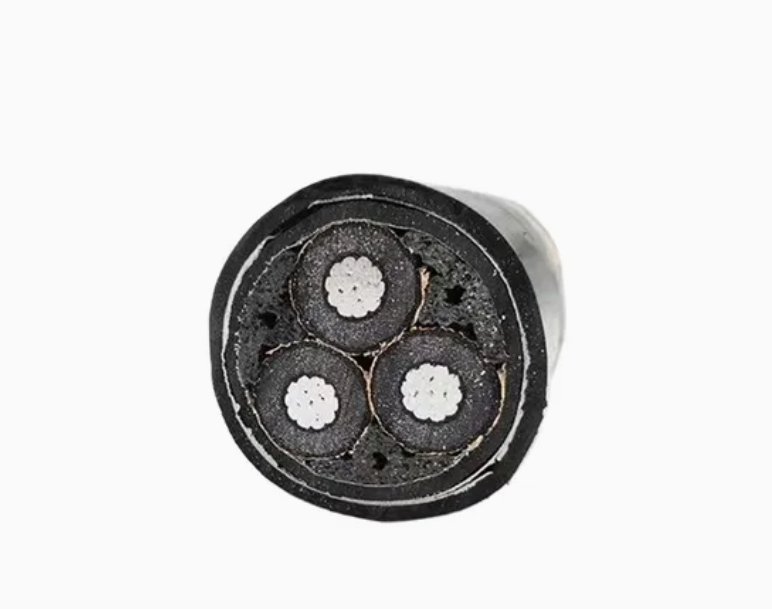
Cross-linked cables are generally composed of three parts: conductor, insulation and sheath.
1. Conductor
A conductor is an object that can conduct electric current, also known as a conductive core. The material used as the conductor of the wire and cable must first have good conductivity, that is, the resistance should be small to reduce the loss of the current on the line. The loss is directly related to the magnitude of the current and resistance, and is manifested in the heat generation of the conductor.
Cables use conductors to conduct current, so the specifications of wires and cables are represented by the cross-section of the conductor.
The conductor of the power cable can be made of a whole solid or a single wire twisted, and the shape can be round and fan-shaped structure. The stranded core can be used in both non-pressing and pressed cores. The conductive core of cross-linked cables is usually stranded structure, and 1kV cross-linked cables are usually fan, semi-circular and round. Cross-linked cables above 6kV adopt round tight core wires.
(1) Round conductive wire core
Round conductive core, its stranding arrangement generally adopts the form of "regular stranding", the twisting principle is:
1) The center is generally a single line, the second layer is six single lines, and each layer is six more than the inner layer in the future, and the single line adopts the same wire diameter.
2) The twisting direction of each layer of single wire should be opposite to the direction of the previous layer, and the outermost layer should be stranded in the left direction. This structure ensures the stability and flexibility of the cable conductive core.
(2) Sector-shaped and semi-circular conductive wire cores
Sector and semicircular conductive cores are not ideal symmetrical shapes, so it is extremely important to design multiple core arrangements with stability in the case of bending. In order to make the non-pressed sector core have sufficient flexibility and stability, the following rules must be observed when designing the unpressed sector core:
1) Central wire rule The central wire of the sector core must be located on the center line of the sector core, otherwise, when the core is bent, the upper wire located on the center line will be stretched, and the lower part will be compressed and may be extruded, which will cause sector damage and damage the insulation.
2) Sliding rule The diameter of the wire on the center line of the sector core is generally larger, and the wires on both sides of it should be able to slide along the wire on the center line without changing the shape of the sector core, this rule is called the sliding rule, otherwise, when the sector core is twisted into a cable, the sector may be damaged and damage the insulation
2. Insulation
Insulation is made of insulation materials wrapped outside the conductor with different thicknesses according to the requirements of their withstand voltage, which plays the role of isolating the charged body from other parts. The material of the insulation layer must have good electrical insulation properties, which is mainly manifested in the size of the withstand voltage. Generally speaking, the thicker the insulation layer of the same mass, the higher the withstand voltage.
Insulation should also have certain mechanical physical properties and process performance of processing and manufacturing. For example, when manufacturing low-voltage cables, although thin insulation can be used from the perspective of electrical properties, it is still better to be slightly thicker from the perspective of mechanical properties and processing technology, because the insulation is too thin, processing is more difficult, and it is easy to damage. After the cable is energized, the conductor heats up. Therefore, the ideal insulation material should have good insulation performance and good thermal conductivity.
Under the action of electricity and heat, the insulation will change internally, and over time, the insulation performance will decrease. Cross-linked polyethylene has excellent electrical insulation properties, after crosslinking, its heat resistance and mechanical properties are greatly improved, is the ideal insulation material at present.
After the conductor is coated with an insulating layer, it is called an insulated core. The insulation layer on each conductor is called the insulation of the wire core or simply the core insulation.
According to the national standards GBl2706 and GBll017, the insulation thickness of cross-linked cables of different voltage levels is shown in Table 1-1.
Table 1—1 Insulation thickness of cross-linked cables
previous page:
Related information
Key Features of 8.7/15kV Triple Core Aluminum Power Cables Explained
Key Features of 8.7/15kV Triple Core Aluminum Power Cables Explained In the realm of electrical engineering, choosing the right type of cable is crucial for ensuring efficient power transmission. One of the widely used cables in medium-voltage applications is the 8.7/15kV triple core aluminum power cable. This article delves into the key features of these cables, exploring their construction, adva
2026-10-04


Understanding 0.6/1kV Single Core Copper Conductor Power Cables
When it comes to electrical installations, choosing the right power cable is crucial for safety, efficiency, and longevity. One significant option in the market is the 0.6/1kV single core copper conductor power cable. This type of cable is designed to handle medium voltage applications, making it suitable for various industrial and commercial settings. The designation 0.6/1kV indicates that the ca
2026-09-27

Exploring the Durability of 8.7/15kV Aluminum Power Cables: A Comprehensive Guide
Exploring the Durability of 8.7/15kV Aluminum Power Cables Table of Contents 1. Introduction to 8.7/15kV Aluminum Power Cables 2. Understanding Power Cables and Their Importance 3. Aluminum vs. Copper: Material Comparison 4. Factors Affecting the Durability of 8.7/15kV Aluminum Power Cables 5. Applications of 8.7/15kV Aluminum Power Cables 6. Industry Standards for 8.7/15k
2026-09-20
0
Hunan Huatai Cable Co. LTD
Xiadopu Machinery Industrial Park, Ningxiang, Xiangjiang New District, Hunan Province

Follow us